
Why Rotation Beats Daily Improvising
Every night you stand in front of the fridge asking “what should we eat?” is a night you’re spending mental energy you don’t get back. That question, multiplied by seven days a week and fifty-two weeks a year, adds up to a lot of tired decision-making right at the point in the day when you have the least patience for it. It’s also the exact moment impulse takes over — the moment a takeout order gets placed because nobody can agree, or a cart fills up with random ingredients that don’t quite become a meal.
A rotating meal plan solves this by moving the decision upstream. Instead of deciding what’s for dinner fourteen times a month, you decide it once, build a loop, and then just follow the trail markers. You already know where the path goes, so there’s no standing at a fork in the woods every evening wondering which way to go.
The grocery savings follow almost automatically. When you know Tuesday is always some form of beans-and-rice night and Friday is always pizza night, you can buy the ingredients for those meals in sensible bulk quantities, use up what you have before it spoils, and stop buying the same forgotten jar of something three times because you didn’t realize you already owned it. Rotation also means your grocery list becomes a known, shrinkable quantity rather than a fresh improvisation every single week.
There’s a psychological bonus too: a two-week rotation is long enough that nobody feels like they’re eating the same five dinners on a loop, but short enough that you’re not reinventing the wheel constantly. It’s the sweet spot between “boring” and “exhausting to plan.”
Mapping Out Your Household’s Regular Favorites
Before you build anything, take stock of what your household already reliably eats without complaint. This is not the time to plan aspirational meals you saw online and have never actually cooked. This is an inventory trip, not a scouting mission into unknown territory.
Grab a notebook or open a blank note on your phone and answer these for your household:
- What do we cook on repeat already? Think about the last month. What showed up more than once without anyone planning it that way?
- What does everyone actually eat? Separate “foods I enjoy cooking” from “foods that get eaten without a fuss.” The rotation needs to lean on the second category, especially early on.
- What’s our protein lineup? Most households cycle through four to six proteins: a chicken dish, a ground-meat dish, a bean or lentil dish, maybe fish, maybe eggs-for-dinner. List yours.
- What’s our “emergency night” meal? The one that takes ten minutes when everyone’s tired. Breakfast-for-dinner, a big bowl of pasta, quesadillas. Build it in on purpose instead of resorting to it by accident.
- What pantry staples do we always have on hand? Rice, pasta, canned tomatoes, frozen vegetables, tortillas. These become the connective tissue between meals.
Once you have that list, you’re not inventing fourteen new dinners — you’re just arranging ingredients you already trust into a sequence. This is the difference between building a trail and bushwhacking: the ground is already familiar, you’re just laying down a path through it.
A good rule of thumb is to aim for roughly 10–14 core dinners that you genuinely like making and your family genuinely eats, then let a couple of “wildcard” slots stay open for whatever’s about to go bad in the fridge, a new recipe you want to try, or leftovers night. That flexibility keeps the rotation from feeling like a rigid schedule instead of a helpful default.
A Worked Example Two-Week Plan
Here’s an illustrative two-week rotation for a household of four. Treat the specific dishes as a template — swap in your own staples from the list you just made. The point is the structure: a repeating rhythm with some built-in flexibility.
Week One
- Monday — Sheet-pan chicken and roasted vegetables. Whatever vegetables are cheapest or about to turn.
- Tuesday — Bean and rice bowls. Canned or dried beans, rice, whatever toppings are on hand.
- Wednesday — Big pot of soup or chili. Doubles as next day’s lunch.
- Thursday — Pasta with a simple sauce. Tomato-based or a quick garlic-and-oil version.
- Friday — Homemade pizza night. Store-bought or homemade dough, whatever toppings are around.
- Saturday — Wildcard night. New recipe, use-up-the-fridge stir fry, or a family favorite nobody’s made in a while.
- Sunday — Roast or slow-cooker meal. Something that produces leftovers for the week ahead.
Week Two
- Monday — Leftover remix. Sunday’s roast becomes tacos, sandwiches, or a grain bowl.
- Tuesday — Stir-fry night. Whatever protein and vegetables are on hand, over rice or noodles.
- Wednesday — Breakfast for dinner. Eggs, toast, maybe pancakes. Low effort, high morale.
- Thursday — Baked potato or sweet potato bar. Toppings bar style, everyone builds their own.
- Friday — Quesadillas or burritos. Beans, cheese, leftover roast meat, whatever’s in the fridge door.
- Saturday — Wildcard night. Same as week one — flexible by design.
- Sunday — Big batch pasta bake or casserole. Something that reheats well for Monday lunches.
Notice the pattern: each week has one “big cook” that deliberately produces leftovers, one very low-effort night, one totally open wildcard slot, and a handful of reliable mid-effort meals in between. After two weeks, you simply start the loop again. Because the plan repeats, your grocery list for week three is nearly identical to your list for week one — which is where a lot of the savings quietly happens. You’re not relearning what to buy; you’re reordering it.
If you want to push the efficiency further, batch-cook components rather than full meals. A big tray of roasted vegetables, a pot of rice, and a pound of browned ground meat can each get repurposed two or three different ways across the two weeks — tacos one night, a grain bowl the next, a quick soup after that. Think of it like packing a trail bag: a few versatile core items that mix and match beats packing a brand-new outfit for every single day.
Adjusting the Rotation as Seasons Change
A good rotation isn’t set in stone — it’s more like a trail map you redraw a couple of times a year as the terrain shifts. What works in January doesn’t necessarily work in July, and a plan that never adapts will eventually feel stale and get abandoned.
A few natural checkpoints for revisiting your rotation:
- Hot weather vs. cold weather. Swap heavier soups, roasts, and casseroles for lighter grain salads, grilled proteins, and cold noodle dishes when it’s warm. Bring the slow-cooker meals back when it cools down.
- School year vs. summer. If your household’s schedule changes with the school calendar, your weeknight effort budget probably changes too. Build in more low-effort nights during the busiest stretches.
- What’s actually affordable right now. Produce and even some proteins shift in price and availability through the year. If a vegetable that anchored a favorite dish is suddenly pricier or out of season, swap it for whatever’s currently abundant rather than paying a premium to keep the dish exactly the same. The rotation should bend to the season, not fight it.
- Boredom check. Every couple of months, ask the household: what are we tired of? What do we miss? Retire one dish, add another. A rotation that evolves slightly stays interesting; one that never changes eventually gets skipped in favor of ordering in.
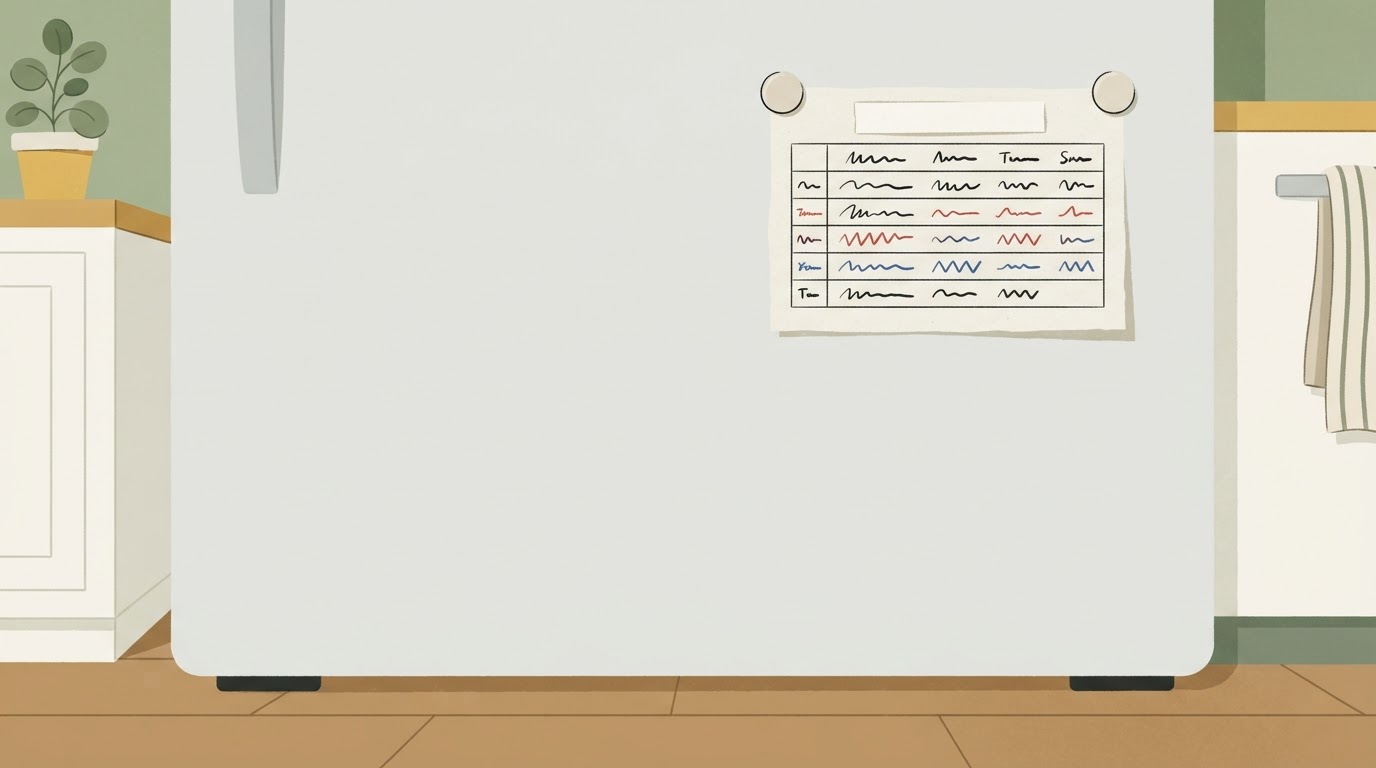
It also helps to keep your two-week plan written down somewhere visible — a sheet on the fridge, a shared note on your phone — rather than just in your head. That way anyone in the household can glance at it and start prepping without having to ask you what’s happening tonight. The whole point of a rotation is to stop being the only trail guide; once it’s written down, everyone can read the map.
Give any new rotation about a month before judging it. The first week or two is where you’ll notice the kinks — a dish nobody actually likes as much as you remembered, a night that’s consistently too rushed for the meal assigned to it. Adjust, don’t abandon. The goal isn’t a perfect plan on the first try; it’s a reliable, low-friction default that frees up your evenings and keeps your grocery list predictable, so the real decision-making energy you save can go toward literally anything else.