
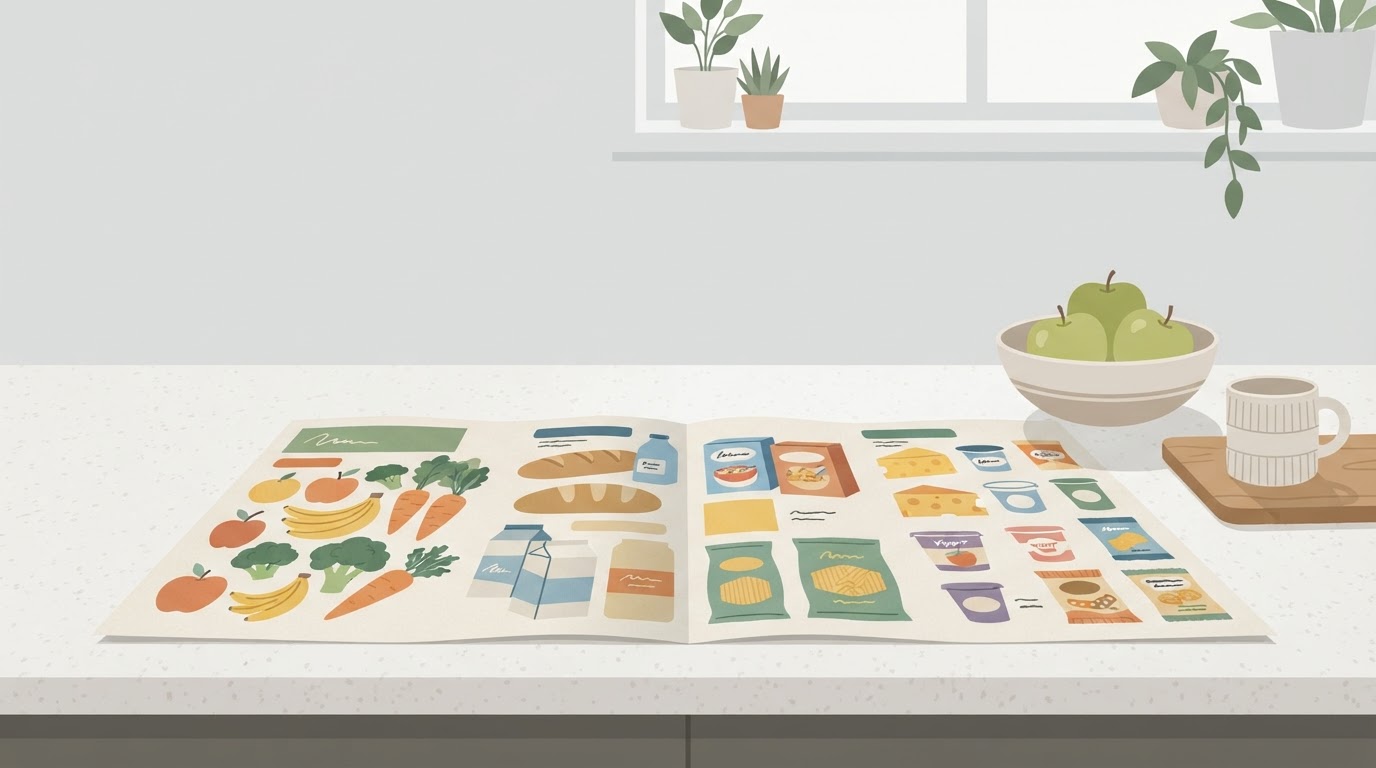
Grocery prices feel random until you notice they’re not. Most stores run on a weekly cycle: a new sale period starts on the same day every week, certain categories rotate in and out of discount on a predictable rhythm, and the flyer you get in your inbox or mailbox is basically a map of that rhythm. Once you can read the map, you stop reacting to whatever’s on sale the day you happen to shop and start building your meals around what’s cheap that week on purpose. That’s the whole trick. No couponing marathons, no spreadsheets at midnight — just planning your route before you set out instead of wandering and hoping.
How weekly sales cycles typically work
Grocery retailers plan their promotions well ahead of time, often working several weeks or even months in advance with their suppliers. The flyer that lands this week was decided a while ago, which means sale patterns aren’t random — they repeat. A few things tend to hold true across most US grocery chains:
- There’s a fixed sale-week start day. Many stores flip to a new weekly ad on the same day each week, often midweek rather than Monday. Check your store’s flyer for the date range printed on it to find your store’s pattern.
- Categories rotate, not just items. One week it’s a deep discount on poultry, the next it swings to beef or pork, then back around. Produce sales often follow what’s currently in heavy supply, so they shift with the growing season. Pantry staples, cleaning products, and canned goods tend to go on deeper rotation tied to seasonal promotions — think soup in colder months, grilling items in warmer ones.
- Loss leaders exist to get you in the door. Stores will price a handful of items very attractively, expecting that once you’re there for the discounted item, you’ll fill the cart with regular-priced groceries too. That’s not a trap you need to avoid — it’s just useful to recognize so you take the deal and skip the impulse add-ons.
- Clearance markdowns happen on their own schedule. Separate from the weekly flyer, perishable items nearing their sell-by window often get marked down on specific days, frequently early in the morning when staff restock. This varies store to store, but if you shop the same place regularly, you’ll start to notice when the orange “reduced” stickers tend to appear.
None of this requires insider knowledge. It just requires paying attention for a few weeks in a row.
Spotting patterns in your local store’s flyer
You don’t need to analyze every grocery chain in the country — you need to understand the one or two stores you actually shop at. Here’s a simple way to build that picture over a month or so:
- Save the last four to six flyers. Keep digital copies if your store emails them, or snap a photo of the paper version before it goes in the recycling bin. Having several side by side is what reveals the rotation — one flyer alone just looks like a list of today’s prices.
- Track by category, not by brand. Don’t worry about whether a specific brand of chicken thighs was on sale. Note the broader pattern: “poultry discounted,” “canned beans discounted,” “root vegetables discounted.” Patterns show up at the category level much faster than at the brand level.
- Mark the start-of-week item. Most flyers feature one or two “anchor” deals on the front page — usually a protein or a seasonal staple. These front-page items are often the best indicator of what category is in its discount window that week.
- Note roughly how often each category reappears. You might find chicken shows up heavily discounted close to every other week, while a particular cut of beef shows up roughly monthly. You don’t need exact precision — “about every two weeks” is plenty useful for planning purposes.
- Watch for seasonal flags. Flyers lean hard into what’s seasonally abundant or tied to upcoming holidays. Produce especially follows this — berries cheaper in summer, citrus cheaper in winter, squash and root vegetables cheaper in fall. Planning meals around what’s naturally in its low-price season is one of the easiest wins available.
After a month of casual tracking, most households can predict with decent accuracy what category will be discounted in any given week. That’s the point where meal planning gets dramatically easier, because you’re not asking “what should we eat?” in a vacuum — you’re asking “what’s cheap this week, and what can we make with it?”
A worked example meal plan built around a sale week
Here’s an illustrative week to show how this works in practice. Suppose your flyer-tracking shows that this particular week has poultry and root vegetables as the discounted anchors, with canned tomatoes also in a promotional window. (These numbers and items are just an example — your actual flyer will differ.)
Example sale-week staples: bone-in chicken thighs, carrots, potatoes, onions, canned tomatoes.
Instead of planning seven unrelated dinners, you build the week around those five items appearing in different forms:
- Monday: Roasted chicken thighs with carrots and potatoes — one tray, minimal cleanup, and it uses the discounted protein and both discounted vegetables in one shot.
- Tuesday: Chicken and vegetable soup using leftover roasted chicken pulled off the bone, plus more carrots and onion, simmered with broth made from the leftover bones.
- Wednesday: A simple tomato-based pasta sauce using the discounted canned tomatoes and sautéed onion, with whatever protein or beans you already have in the pantry.
- Thursday: Loaded baked potatoes using the discounted potatoes, topped with whatever’s left of the chicken, plus any vegetables that need using up.
- Friday: A pantry-clearing fried rice or grain bowl using small amounts of everything left over from the week — this is the night that keeps your fridge from turning into a science experiment.
- Weekend: One “free” meal built from whatever you already have, plus maybe one fresh item that wasn’t part of the sale but rounds things out — this keeps the week from feeling repetitive.
Notice the shape of this plan: one primary shopping trip built almost entirely around five sale items, with meals designed to use the same core ingredients in different forms so nothing goes to waste. That’s the meal-planning version of walking a loop trail instead of backtracking — you cover the same ground efficiently instead of doubling back for ingredients you forgot.
The pantry items you’d add around these five anchors — broth, pasta, rice, onions if you didn’t already have them, basic seasoning — are things worth keeping stocked at all times precisely because they make any sale-week anchor flexible. A well-stocked pantry of neutral staples is what lets you build a week around literally whatever happens to be discounted, rather than needing chicken specifically or beef specifically.
Stocking up without overbuying
The natural next question is: if chicken’s cheap this week, should you buy six packages and freeze them? Sometimes yes — but “sale” and “worth stockpiling” aren’t automatically the same thing, and overbuying is where a lot of grocery savings quietly leak back out.
- Only stock up on what you’ll actually eat. A deep discount on an ingredient your household doesn’t like isn’t a deal, it’s clutter in your freezer. Stockpiling only pays off on things already in your regular rotation.
- Match the quantity to your storage reality, not the discount. If your freezer is already full, buying more meat just means something else thaws, spoils, or gets shoved to the back and forgotten. Know roughly how much usable freezer and pantry space you actually have before you commit to a bulk buy.
- Check that the per-unit price is genuinely better, not just the package bigger. A larger package on sale isn’t always cheaper per pound or per ounce than the regular-size package at its normal price. It takes ten seconds to do the unit-price comparison, and it’s worth doing before assuming “bigger discount” equals “better deal.”
- Respect shelf life, even in the freezer. Freezing pauses spoilage, it doesn’t stop quality decline. Meat, bread, and most produce have a reasonable freezer window before texture and taste suffer. Buying twelve weeks of chicken because it’s on sale only makes sense if you’ll realistically cook through it before quality drops — otherwise you’re just paying to store food you’ll eventually toss.
- Rotate what you already have. Before buying more of a sale item, do a quick check of what’s already in the back of your pantry or freezer from the last time it was on sale. The goal is a rotating stock you’re always eating through and replenishing — not a growing stack you’re never catching up on.
- Separate true pantry staples from perishable sale items. Shelf-stable goods — canned goods, rice, dried beans, pasta — are much more forgiving to stock up on when discounted, since they’ll wait patiently until you need them. Perishables deserve more caution and a realistic eating timeline before you commit to extra quantity.
Think of sale cycles the way you’d think of trail conditions: useful information that tells you the easiest path this week, not a reason to load your pack heavier than you can comfortably carry. The households that save the most over time aren’t the ones buying the most on sale — they’re the ones who’ve simply stopped fighting the current, letting the weekly flyer suggest the meals instead of the other way around. Give it a month of casual flyer-watching, and planning dinner starts to feel a lot less like a chore and a lot more like following a map you’ve already walked before.