
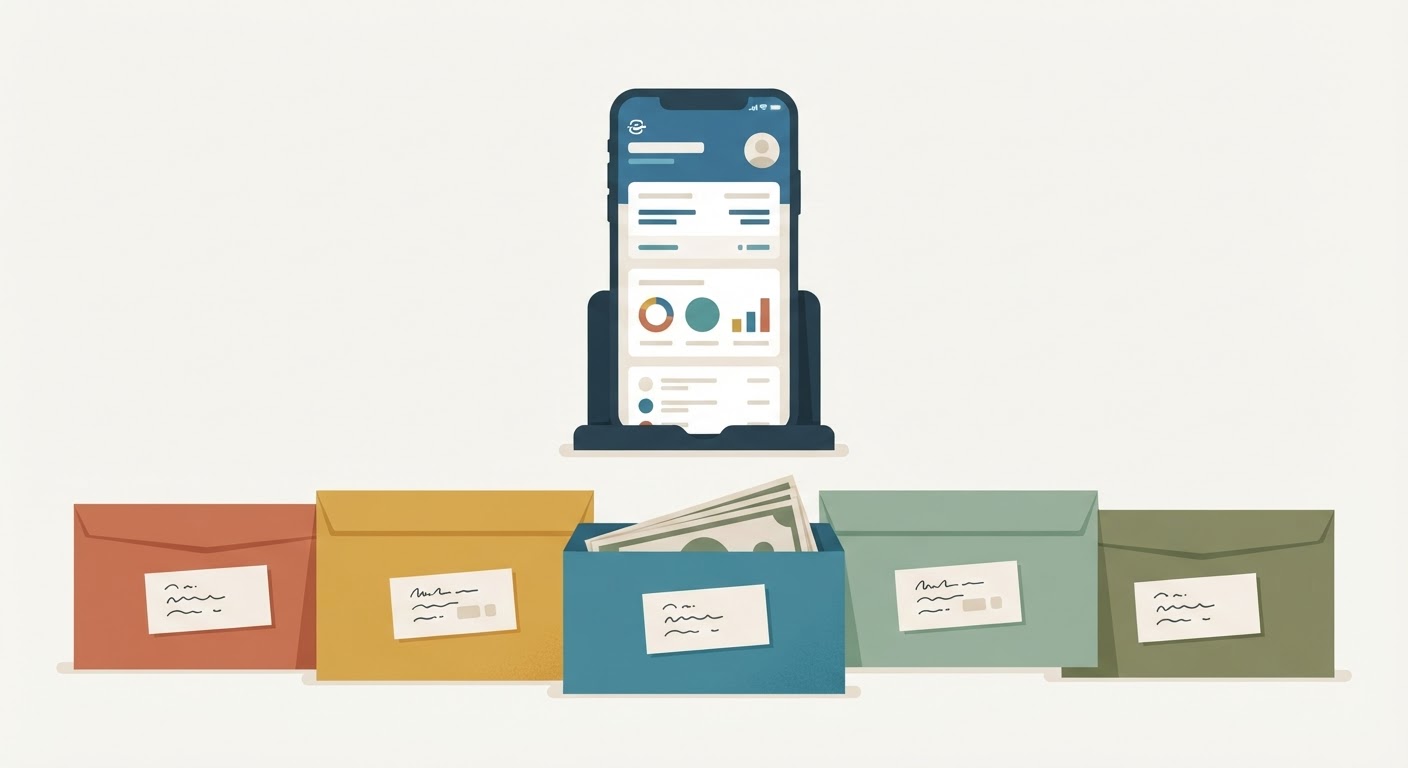
There’s a reason the envelope method has survived decades of budgeting trends: it works with human psychology instead of against it. When money is divided into visible, finite piles before you spend a dime, every purchase becomes a choice between “this” and “something else in this same envelope later.” That’s a very different mental experience than swiping a card and finding out the damage at the end of the month. The trouble is, most of us don’t carry much cash anymore, so the literal envelopes have mostly disappeared from kitchen drawers. The good news is that the logic behind them transfers just fine to a cashless life — you just need a few digital stand-ins that do the same job.
Why the envelope method still works
The classic version is simple: you take your paycheck, divide it into categories like groceries, gas, and fun money, and physically put that cash into labeled envelopes. When an envelope is empty, spending in that category stops until the next pay period. No overdraft, no “I’ll just put it on the card,” no vague sense that there’s probably still money somewhere.
What makes this effective isn’t the paper — it’s three things happening at once:
- A hard limit per category. You can’t accidentally spend your electric bill money on takeout because it’s in a different envelope.
- Immediate visual feedback. A thin envelope on day twenty of the month tells you to slow down without needing a spreadsheet.
- Friction before overspending. Running out of cash in an envelope means a real stop, not a soft suggestion.
Cash happened to be a convenient way to create those three conditions, but it’s not the only way. If you can recreate a hard limit, visible feedback, and a moment of friction using your phone or bank accounts, you get the same behavioral benefits without ever touching a bill.
Digital alternatives that mimic physical envelopes
There are a few different approaches here, and you can mix and match depending on how hands-on you want to be.
Multiple bank accounts as envelopes
Many banks and credit unions let you open several checking or savings sub-accounts at no cost, each with its own balance you can check instantly in the app. Treat each one as an envelope: one for groceries, one for gas, one for household goods, one for “fun money.” On payday, you divide your money between them, either manually or through automatic transfers your bank sets up for you. When a sub-account hits zero, that category is done for the period — exactly like an empty envelope, just viewed on a screen instead of felt in your hand.
Budgeting apps with category caps
Budgeting apps that let you set a spending cap per category and track it against your linked card transactions are essentially digital envelopes layered on top of a single bank account. The money doesn’t physically move, but the app shows you a shrinking balance for “dining out” or “clothing” as you spend, often with a notification when you’re close to the limit. This keeps the visibility and the warning, even though the friction of running out is slightly softer since the card will still technically work.
Prepaid or reloadable cards per category
Some households load a fixed amount onto a reloadable prepaid card at the start of the month for a specific category — say, entertainment or personal spending — and use only that card for those purchases. Because the card declines once the balance hits zero, this recreates the hard stop of an empty envelope almost exactly. It’s a good option if you want one category to have real teeth without restructuring your whole bank setup.
The weekly transfer habit
If opening multiple accounts feels like overkill, a simpler version is to transfer a set amount into a single “spending” account each week — like refilling one envelope on a schedule — and track remaining days against remaining balance mentally. It’s less precise than full category envelopes but still creates a visible, finite pool instead of an abstract paycheck.
A worked example monthly envelope breakdown
Here’s an illustrative setup for a household bringing in a take-home pay of roughly $4,000 a month (this is a simplified example — plug in your own numbers). The goal isn’t to copy these categories exactly, but to see how a paycheck gets divided into purposeful, trackable chunks.
- Groceries: $500 — its own sub-account, refilled each payday.
- Gas and transportation: $200 — covers fuel and parking, tracked in the budgeting app.
- Household essentials: $150 — cleaning supplies, toiletries, the small stuff that adds up.
- Dining out and takeout: $150 — deliberately separate from groceries so it can’t hide inside that category.
- Personal/fun money (per adult): $100 each, $200 total — loaded onto individual reloadable cards so there’s no guilt-tripping over small purchases.
- Clothing and incidentals: $100 — a rolling envelope that can carry over if unused.
- Bills and fixed costs: $1,800 — rent/mortgage, utilities, insurance, paid directly from the main account since these don’t need envelope treatment.
- Savings and buffer: remainder — whatever’s left after the above gets moved to savings or a buffer account before it can quietly evaporate into “miscellaneous.”
Notice that fixed bills don’t get an envelope — they’re predictable and automatic, so the envelope system is really reserved for the categories where impulse and daily decisions matter most. That’s the sweet spot: variable spending that fluctuates week to week benefits most from a visible, shrinking balance.
If, partway through the month, the dining-out sub-account is down to $20 with ten days left, that’s your cue to cook at home more often — not a crisis, just useful information arriving right when you need it, the same way a thin paper envelope would have told you decades ago.
Staying honest with yourself without cash in hand
The biggest risk of the digital version is that it’s easier to cheat. A card doesn’t jam when an account is empty the way an empty envelope stops your hand. So a bit of self-management goes a long way.
- Check balances before you shop, not after. Make it a habit to glance at the relevant sub-account or app category before you’re standing in a checkout line, not as a post-mortem once the money’s gone.
- Turn on low-balance alerts. Most banking apps can notify you when a sub-account drops below a threshold you set — this recreates the “envelope feels light” sensation digitally.
- Resist the transfer-to-cover-it reflex. The whole point collapses if you routinely move money from the grocery envelope to cover a dining-out overspend. If you do need to borrow between categories occasionally, treat it as a deliberate decision you write down, not a silent habit.
- Review weekly, not just monthly. A five-minute Sunday check-in — how’s each envelope doing, is anything running low — keeps small overspends from snowballing into a category that’s broke by the fifteenth.
- Let unused money roll over, within reason. One of the quiet joys of envelope budgeting is a category that comes in under budget. Let those small surpluses build up a little cushion in that same category rather than immediately redirecting them elsewhere — it rewards the discipline instead of punishing it.
The physical envelope’s magic was never really about the paper — it was about making your money visible, divided, and finite before temptation showed up. Rebuild those three conditions with sub-accounts, app caps, or reloadable cards, and you get all the benefits of the old system with none of the trips to the bank for cash. Pick the version that matches how hands-on you want to be, set it up once, and let the structure do the work of keeping your spending on the trail you actually meant to take.